

Purdue’s Ilana Stonebraker: “Usually women don’t see themselves in office until they have things they need to change.”
In 2018, a record number of women across the United States ran for — and won — political office, including two professors from Purdue’s West Lafayette campus.
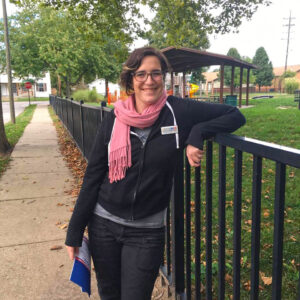
Ilana Stonebraker, associate professor of library science and business information in Purdue University Libraries, was elected to the Tippecanoe County Council. Stonebraker earned a master’s degree in information science from the University of Michigan in 2012 and joined the Purdue faculty that same year.
We asked her about her decision to run, increasing the number of women in office, and what she hopes to accomplish on the Tippecanoe County Council.
To start, tell us about how you decided to run for office. Was this something you’ve planned or hoped to do?
My process toward running started when I was teaching a freshmen business research course. Every day I would drive by the MatchBOX Coworking Studio, which was running a “How can we make Greater Lafayette even greater?” art installation. I like to use problem-based learning in my class, but I realized that many of the cases I would use in class usually had to do with just making one person or company rich. I started making the problems more collaborative with a greater focus on the local community.
Eventually this concept outgrew the freshmen class and I started teaching the concept as a sophomore honors course — Making Greater Lafayette Greater — that expanded upon that notion of looking systematically at problems to improve the community. At the same time, I started looking at my own community a little more systematically as well. I was meeting local officials, making lots of connections. After the 2016 election, I started going to candidate trainings, and became interested in county council because of the connections I had made earlier.
How did your background with Purdue prepare you for public office?
Purdue is an institution that thinks seriously about the impact we make on the world around us and focuses our efforts into greater change. I teach economic development, which is one of the main areas where county council has an influence. I try to push my students to think more holistically about the community. I spend a lot of time trying to make people care about things they don’t think affect them — or develop skills they don’t realize they need.
Polling shows that men are about twice as likely to consider running for office than women. Why do you think that is — and how do we change that?
As a woman running for office, my biggest obstacle was being seen as a viable candidate, even though I’m a tenured professor who teaches business courses.
I remember reading that men typically run for office because they have always seen themselves as politicians, whereas women run for office because they want to change things. Women run because someone should do it, and this time it’s their turn. We need to keep in mind that women often don’t spend their lifetimes visualizing politics as their next move. Usually they don’t see themselves in office until they have things they need to change.
The question shouldn’t be, “Have you imagined yourself running for office?” We should instead ask women, “How would government be different if someone like you was represented there?”
Can you talk about the importance of having the right network in place as women work into historically male-dominated environments — whether it’s politics, the boardroom, a discipline or profession?
I do know that women are much less likely to be helped by their network than their male peers, so it is important that they have a wide network. Women cannot rely on specific, individual connections as reliably as men, so it is more important for them to have a large number of diverse connections. And I think it’s important as women to hold space for others who are left out, like transwomen, minorities, even different generations.
How did you find campaigning? What surprised you, and what kept you going?
As a first-time candidate, I was initially anxious about campaigning. I was afraid of people trying to trip me up with tricky questions. But the more I did it, the more I found I really liked it. I especially liked knocking on doors.
One of my goals in my teaching is to invite people to collaborate with their community, and when you think about it, canvassing is doing that at every door. It felt really good to ask people to open their doors and speak with me about their hopes and dreams for our community.
In total, I knocked on over 2,000 doors. Not every interaction at someone’s door is positive, but I think that overall people are very grateful to find out about county government, and to know there are people out there willing to work to improve the county.
What do you hope to accomplish while you’re in office?
While I was out knocking doors, it really hit me how little people understand about county government, and I really hope to change that.
My goal in my first year is to communicate decisions being made at the local government level to a larger public. Over the next four years, I hope to invite more people into local government by making the county council process more transparent and community-involved. I want to make recordings for the meetings accessible to everyone, and to create a series of “citizen academy” sessions where local residents can learn about how local government functions.
What words of wisdom do you have for people who want to have an impact on their community — whether in elected office or other avenues?
A lot of people want to give back to their communities. They want to help people in the same way that they have been helped. But when they think about the ways to get involved, they get intimidated — and I think it’s important to keep doing these scary, intimidating things. It can be very easy as a professional to get really good at few things and not look for more. That’s why it’s important to continue to invite new people into the process.
Purdue Women have been taking giant leaps for 150 years, and 2019 is no exception.
Learn how the Purdue Women’s Network is having an impact.
The Purdue Women’s Network creates an alumnae sisterhood that motivates, inspires, uplifts, and connects Purdue alumnae now and for life. For good.
About the Purdue Alumni Association
Founded in 1878, the Purdue Alumni Association harnesses the power of 630,000 alumni and a world-class institution to enrich the personal, professional, and intellectual lives of alumni and students and advance the University’s mission. It provides endless opportunities through its programs, services, and resources to keep the University a strong, vital part of alumni’s lives, regardless of where they are in the world, and to foster lifelong learning.